Subcontratante de precisão fiável para oficinas de ferramentas







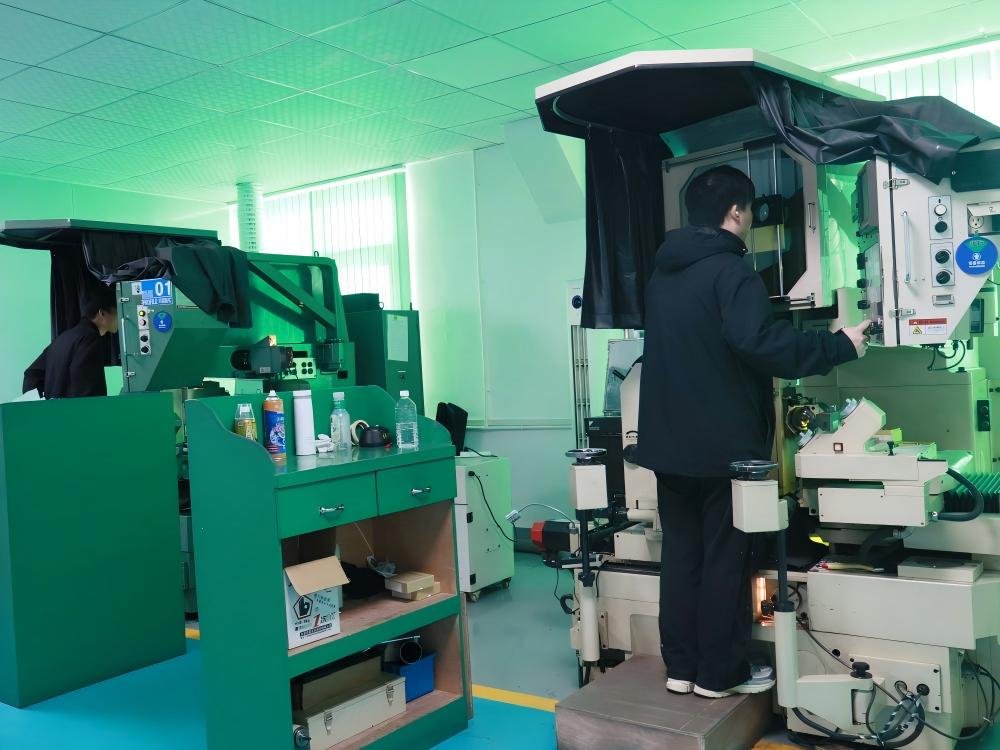
Precision Profile Grinding (PG) – Waida High-Precision SolutionsProfile Grinding (PG) delivers high-precision contour and profile machining where part function depends on shape accuracy rather than size alone. Our Waida PG machines enable repeatable precision, minimal deformation, and superior surface quality.
Process Overview
Profile Grinding is a form-based grinding process:
Wheel Dressing: Diamond dressing creates a negative replica of the target contour.
CNC-Controlled Grinding: Wheel follows precise trajectories with micron-level feed control.
Profile Compensation: Optical and CNC systems allow real-time alignment and correction.
Outcome: Single-pass contour precision without multi-step accumulation errors.
Wheel Dressing: Diamond dressing creates a negative replica of the target contour.
CNC-Controlled Grinding: Wheel follows precise trajectories with micron-level feed control.
Profile Compensation: Optical and CNC systems allow real-time alignment and correction.
Outcome: Single-pass contour precision without multi-step accumulation errors.
Technical Capabilities
| Parameter | Typical Values / Notes |
|---|---|
| Dimensional accuracy | ±0.001 mm |
| Surface roughness (Ra) | 0.1 – 0.2 μm typical |
| Repeatability | ±0.002 mm |
| Minimum feature size | 0.1 mm edge/slot |
| Maximum part size | Up to 400 mm × 200 mm × 150 mm (depends on machine model) |
| Max material hardness | HRC 68 (tungsten carbide, tool steel) |
Key point: PG excels at small, delicate, or thin-walled parts without deformation.
Compatible Materials
- Tungsten carbide & hard alloys
- High-speed steel (HSS)
- Tool steels (SKD11, DC53)
- Stainless steels (SUS series)
- Copper alloys & beryllium-copper
- Heat-treated components
Engineering note: PG can handle post-heat-treated mold components and high-hardness inserts with micron-level contour control.
Typical Applications – Data-Driven
| Application | Part Examples | Key Feature |
|---|---|---|
| Mold & Tool Components | Punches, die inserts, cores, sliders | R-angles, edges, profile critical |
| Precision Cutting Tools | Forming cutters, R-angle cutters, chamfer tools | Contour accuracy ±0.001 mm |
| Mechanical Motion Components | Cam profiles, followers | Profile defines motion accuracy |
| Electronics & Connectors | Terminals, contact springs | Small features, high repeatability |
| Gauges & Fixtures | Profile gauges, reference blocks | Dimensional consistency, low deformation |
| Medical / Precision Instruments | Surgical instruments, micro-cutting edges | Edge precision, complex profiles |
Engineering insight: For parts where profile = function, PG ensures functional integrity.
Advantages vs Other Methods
| Feature | PG | CNC / EDM |
|---|---|---|
| Contour precision | ±0.001 mm | ±0.01 mm typical |
| Surface finish | Ra 0.1–0.2 μm | Ra 0.4–0.8 μm |
| Edge consistency | High | Moderate |
| Material flexibility | Hard steels, carbides | Hard steels, limited carbides |
| Multi-step accumulation | Minimal | Higher, requires secondary finishing |
When to Consider PG Outsourcing
- Critical curves, edges, or profiles
- Small, thin, or delicate parts
- Parts requiring high functional repeatability
- Low-volume, high-precision, or custom shapes
Decision rule: If your part’s performance depends on the contour, PG is often the only practical solution.
Engineering Support & Collaboration
We provide:
- Feasibility analysis: Determine if PG is suitable
- Profile optimization: Suggest modifications for manufacturability
- Accuracy & risk evaluation: Predict tolerances, deformation, and repeatability
- PG vs alternative methods guidance: Avoid costly trial-and-error
CTA: Share your CAD files or technical drawings, and we’ll provide a detailed PG feasibility report with predicted tolerances and achievable surface finish.
 English
  Korean
  Japanese
  Spanish
  Portuguese
  French
  German