Reliable Precision Subcontractor for Tool Shops








Carbide Punches for Copper Alloy Stamping: Why System Stability Matters More Than Material Alone
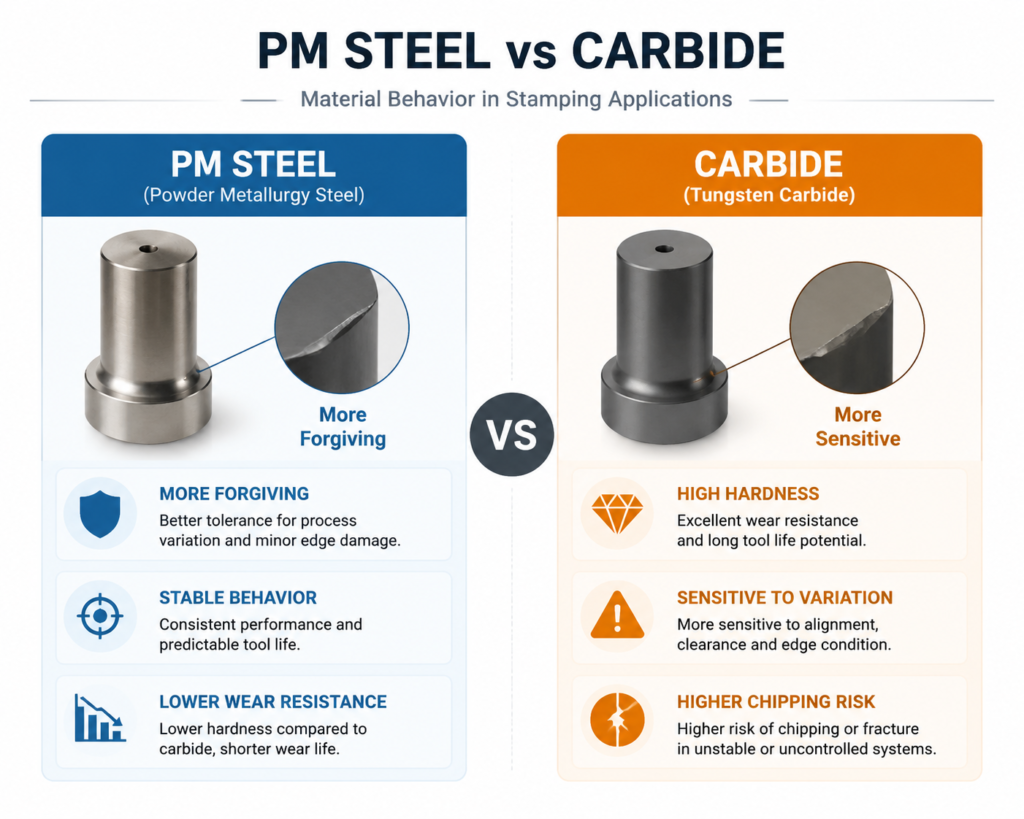
In many stamping applications, upgrading from PM steel to carbide is considered a straightforward improvement.
Higher hardness.
Higher wear resistance.
Longer tool life.
From a material perspective, the logic seems obvious.
However, in precision stamping — especially connector tooling using copper alloys and pre-plated materials — the actual production results are often more complex.
Carbide can provide significant advantages, but simply changing the tool material does not always guarantee a longer and more stable tool life.
The reason is simple:
Tool performance depends on the entire stamping system, not only the material itself.
Carbide Is Not Just a Material Upgrade
We have seen applications where carbide punches did not significantly outperform PM steel in terms of stable production life.
This does not mean carbide is inferior.
Carbide remains one of the most effective materials for demanding stamping applications because of its excellent:
- Wear resistance
- Hardness
- Dimensional stability
However, when switching from PM steel to carbide, the behavior of the entire tooling system changes.
A successful carbide application requires more than selecting a harder material.
It requires controlling the factors that influence how the tool interacts with the stamped material.
Copper Alloy Stamping Creates Unique Challenges
Connector stamping often involves materials such as:
- CuZn30 brass
- CuNiSi copper alloy
- Bronze
- Pre-plated copper materials
These materials introduce challenges that are not always solved by increasing hardness.
Typical issues include:
- Adhesive wear
- Material sticking
- Edge chipping
- Burr formation
- Surface interaction problems
In these applications, tool life is often not limited by bulk hardness.
Instead, performance is strongly influenced by:
- Edge condition stability
- Micro-radius consistency
- Surface finish
- Punch and die alignment
- Stamping process stability
Carbide Requires a Stable Stamping System
One important point is often overlooked:
Carbide does not fix an unstable stamping process.
Before expecting carbide punches to deliver longer tool life, the basic tooling system must already be controlled.
Important factors include:
- Punch and die clearance
- Tool alignment
- Guide accuracy
- Punch support condition
- Lubrication condition
- Edge geometry
For example, incorrect clearance can significantly affect carbide performance.
If clearance is too small:
- Cutting force increases
- Friction increases
- Edge stress becomes higher
- Chipping risk increases
If clearance is too large:
- Burr height increases
- Material deformation increases
- Part quality may become unstable
In these situations, the failure is not caused by insufficient wear resistance.
The real issue is process imbalance.
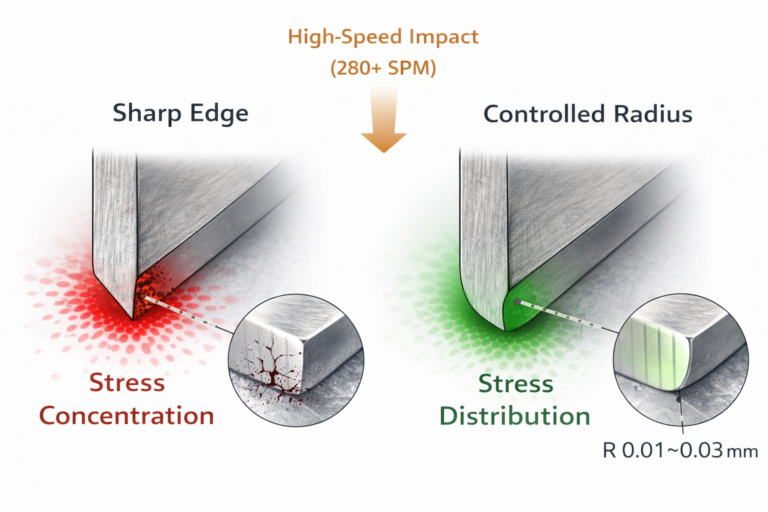
Why Edge Control Becomes More Important with Carbide
Carbide provides excellent resistance against wear, but it is also less tolerant of uncontrolled variables.
Small differences in:
- Edge radius
- Corner transition
- Profile accuracy
- Surface condition
can have a significant influence on tool stability.
This is especially important in connector tooling, where small geometric features directly affect:
- Contact performance
- Assembly reliability
- Production consistency
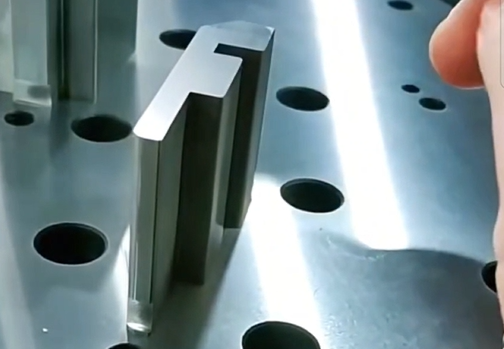
For carbide punches and inserts, manufacturing precision becomes a critical part of tool performance.
The Role of Profile Grinding in Carbide Tooling
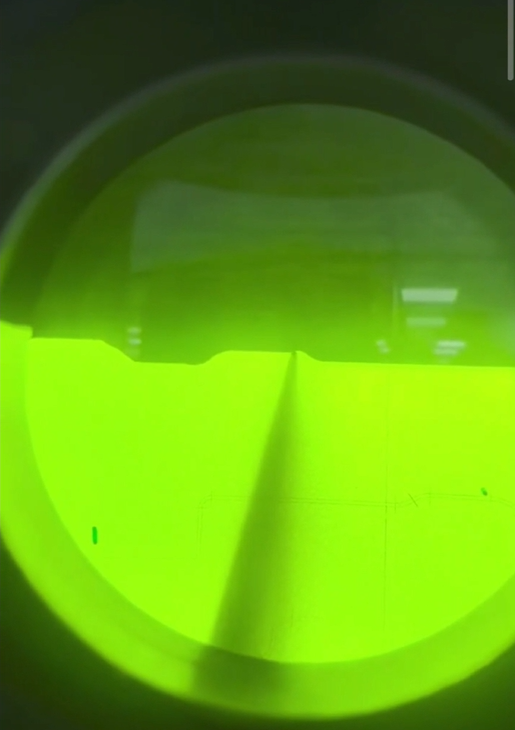
When producing precision carbide tooling components, processes such as Profile Grinding (PG) help control critical functional features.
PG allows manufacturers to achieve consistent control over:
- Complex profiles
- Edge geometry
- Micro-radius requirements
- Repeatability between components
For high-precision connector stamping applications, these details can directly influence whether a tool runs reliably for thousands or millions of cycles.
The Real Question Is Not “Which Material Is Better?”
When comparing PM steel and carbide, the question should not simply be:
“Which material is better?”
The better question is:
“What system changes are required when upgrading the material?”
A successful carbide conversion may require reviewing:
- Material being stamped
- Strip thickness
- Press speed
- Tool geometry
- Clearance
- Edge preparation
- Manufacturing process capability
Only when these factors work together can carbide deliver its full potential.
Conclusion
Carbide punches can provide excellent performance advantages in copper alloy stamping applications.
However, longer tool life does not come from material selection alone.
The best results are achieved when:
- The correct carbide grade is selected
- The stamping system is stable
- Clearance and alignment are controlled
- Edge geometry is consistently manufactured
In precision connector tooling, the strongest solution is not always the hardest material.
It is the solution that creates the most stable production process.
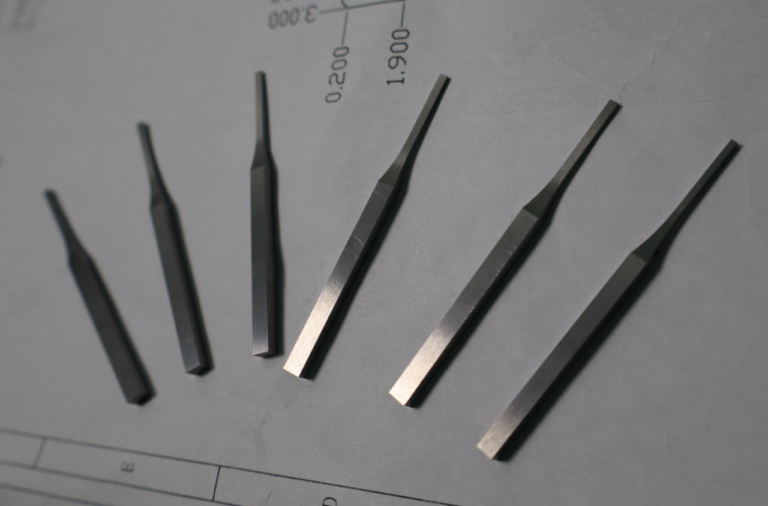
At HEPHA Precision, we manufacture carbide punches, inserts, and precision die components using Profile Grinding (PG) and Wire EDM processes. We support customers with high-precision tooling requirements for connector stamping and progressive die applications.
If you have a tooling project requiring tight profile control or material evaluation, feel free to share your drawings for review.

 English
  Korean
  Japanese
  Spanish
  Portuguese
  French
  German